If you’re visiting the US for the first time and walk into a stationery store, you’ll probably scratch your head at labels like Letter and Legal. But why are these papers totally different from the A4 and A3 you’re used to globally? Actually, these paper sizes are woven into US daily lives, carrying generations of habits and industry traditions. Now let’s slowly unfold the truth.
Why US Paper Sizes hooked on a unique system?
The US paper size system (including Letter, Legal, Half Letter, etc.) took shape in the 19th century, evolving from early American papermaking practices. At that time, paper mills optimized sheet dimensions (such as the 8.5×11 inch) based on raw material availability and production equipment.
So by the time the ISO system was formally established in 1975, the US had already used its own paper sizes for over a century. This early formation of US standards is also why it has maintained its unique system instead of switching to the ISO standard, because changing would have required massive costs to replace equipment and restandardize documents.
And in US, paper sizes aren’t just cold numbers, they evolved with real-life needs, changing the paper size system is a huge project that affects culture and life.
- Before 1921, American paper sizes were chaotic. There once over a dozen sizes just for printing news decades ago. Adjusting the press every time was a total hassle. It wasn’t until the American National Standards Institute (ANSI) stepped in and standardized sizes like Letter, Legal, and Tabloid, etc. that US had a nationwide system.
- Unlike the “mathematical beauty” of international ISO standards (that √2 aspect ratio is pretty clever), US paper sizes are total “pragmatists.” For example, Letter fits perfectly in office file racks, Legal is long enough to cram all the clauses in a legal contract, and a Tabloid sheet can easily accommodate two Letter sheets side by side. All of these are designed for the convenience of daily life and work.
- Even with globalization, many companies now use A4 sized paper, but for most Americans, Letter paper is like hamburgers and cola, US people have used it since childhood, and old habits die hard.
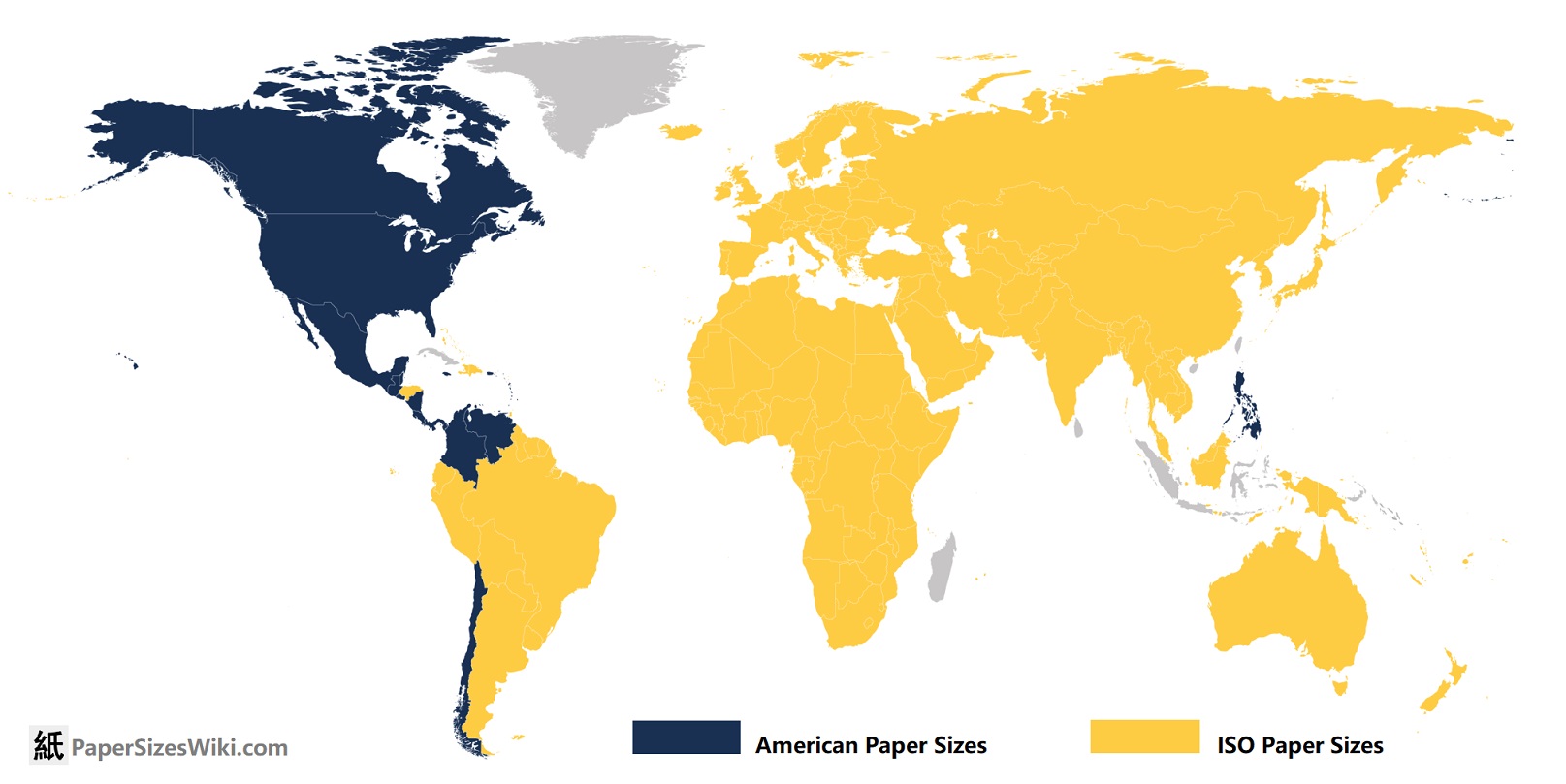
Below you will find the most popular paper sizes used in US. If you want to explore more, please go to the related individual page for the specific information.
Office Paper Sizes in US
In the US, these papers can be seen as the hard currency in schools, offices, and government agencies, and each size has its own specialty here
| Size Name | Inches | cm | mm |
| Letter | 8.5 × 11 in | 21.6 × 27.9 cm | 216 × 279 mm |
| Legal | 8.5 × 14 in | 21.6 × 35.6 cm | 216 × 356 mm |
| Tabloid | 11 x 17 in | 27.9 x 43.2 cm | 279 x 432 mm |
| Ledger | 17 x 11 in | 43.2 x 27.9 cm | 432 x 279 mm |
| Executive | 7.25 × 10.5 in | 18.4 × 26.7 cm | 184 × 267 mm |
| Half Letter | 5.5 × 8.5 in | 14.0 × 21.6 cm | 140 × 216 mm |
| Junior Legal | 5 × 8 in | 12.7 × 20.3 cm | 127 × 203 mm |
| Government Letter | 8 × 10.5 in | 20.3 × 26.7 cm | 203 × 267 mm |
Among all above, paper with Letter size can be called as the national paper in US. People used it for essays and posters in elementary school, printed class notes and college applications in high school, and now the Americans can’t live without it for project reports and client proposals. And a fun saying is, that 11-inch length dates back to the hand-papermaking era. People used to say that a skilled papermaker’s maximum arm span divided by four is about 11 inches, so it was easy to handle and made the most of raw materials, so it became the default. It might be the truth or might not, but just don’t take it seriously.
And Legal, as the name suggests, is tailor-made for lawyers. Lawyer’s filing cabinets are stuffed with Legal-sized folders. These extra 3 inches let them add more liability clauses, and gives everyone peace of mind. For regular folks, though, Legal is rare, it is only used for super-long invoices or official documents.
Popular US Envelopes Sizes
In the US, envelope-paper pairings well, every paper size has its matching envelope, no exceptions. Here are the popular envelope sizes in US.
| Series | Size Name | Inches | cm | mm | Matching Paper |
| Commercial (Business) | #10 | 4.125 x 9.5 | 10.5 x 24.1 | 105 x 241 | Letter (most common) |
| #7 | 3.75 x 6.75 | 9.5 x 17.1 | 95 x 171 | Standard letters | |
| #11 | 4.5 x 10.38 | 11.4 x 26.4 | 114 x 264 | Larger documents | |
| Booklet | 9 x 12 | 22.9 x 30.5 | 229 x 305 | 229 x 305 | Folded booklets |
| Announcement (Invitations) | A-7 | 5.25 x 7.25 | 13.3 x 18.4 | 133 x 184 | Greeting cards, invitations |
People in US send Christmas cards in A-7 envelopes. They fit Letter paper folded twice, plus a family photo, and no tight squeezing when sealing. While at work, people more prefer to use #10 envelopes for client contracts and proposals. Fold Letter paper once, slide it in, and it’s ready for stamping and mailing. Almost every US company does the same.
Engineering Drawings Paper Sizes
If you know any American engineers, they’ll probably rave about the ANSI series. These sizes were made for precise scaling—true “wisdom of the industrial age”. Here are the details.
| Size Name | Inches | cm | mm |
| ANSI A | 8.5 × 11 | 21.6 × 27.9 | 216 × 279 |
| ANSI B | 11 × 17 | 27.9 × 43.2 | 279 × 432 |
| ANSI C | 17 × 22 | 43.2 × 55.9 | 432 × 559 |
| ANSI D | 22 × 34 | 55.9 × 86.4 | 559 × 864 |
| ANSI E | 34 × 44 | 86.4 × 111.8 | 864 × 1118 |
A mechanical engineer would say that the magic of ANSI is folding for scaling. Fold ANSI A (which is just Letter size) along its long edge, you get two ANSI B sheets. Fold ANSI B, you have ANSI C, perfect proportions every time. Back in the day, sketch on small sizes first, then scale up to ANSI D for printing without adjusting ratios – total time-saver.
Even with CAD software now, the system hasn’t changed. All the blueprints on the workshop walls in an auto factory might be ANSI D. The engineers would say that it fits perfectly on their workbenches because they can see every detail clearly, and revisions are a breeze.
Architectural Paper Sizes
In the US, architects almost exclusively use the ARCH series. It’s not that ANSI is bad, ARCH’s integer ratios (4:3, 3:2) make drawings so visually harmonious, they’re perfect for architectural aesthetics:
| Size Name | Inches | cm | mm |
| ARCH A | 9 × 12 | 22.9 × 30.5 | 229 × 305 |
| ARCH B | 12 × 18 | 30.5 × 45.7 | 305 × 457 |
| ARCH C | 18 × 24 | 45.7 × 61.0 | 457 × 610 |
| ARCH D | 24 × 36 | 61.0 × 91.4 | 610 × 914 |
| ARCH E | 36 × 48 | 91.4 × 121.9 | 914 × 1219 |
| ARCH E1 | 30 × 42 | 76.2 × 106.7 | 762 × 1067 |
US architect’s studio walls might be covered in ARCH D drawings. That 24×36 ratio, facade drawings looks neat. Whether the architect displaying them in the studio or showing clients, the visual effect is just right. And the city planning board of a downtown apartment building might be ARCH E, spreading out on the conference table, the entire layout and surrounding greenery would be crystal clear, as the reviewers got it at a glance.
ARCH sizes also make great display posters. Most large designs in architecture exhibitions are ARCH D or E. You can see details from afar and study structures up close, total immersive experience.
US Poster Sizes
| Size Name | Inches | cm | mm |
| Letter Poster | 8.5 × 11 | 21.6 × 27.9 | 216 × 279 |
| Small Poster | 11 × 17 | 27.9 × 43.2 | 279 × 432 |
| Medium Poster | 18 × 24 | 45.7 × 61.0 | 457 × 610 |
| Large Poster | 24 × 36 | 61.0 × 91.4 | 610 × 914 |
Speaking of posters, college campus concerts or club recruitments would be printed on 11×17 Small Posters. They fit perfectly on classroom and cafeteria walls without taking up space, and the info was easy to read. And for the Super Bowl or Hollywood premieres, almost all outdoor ads are 24×36 Large Posters, because they’re really eye-catching from blocks away. Here are more about poster size.
Newspaper / Art / Packaging Paper Sizes
| Size Type | Inches | cm | mm |
| Newspaper (Broadsheet) | 22 x 17 | 55.9 x 43.2 | 559 x 432 |
| Newspaper (Tabloid) | 11 x 17 | 27.9 x 43.2 | 279 x 432 |
| Sketch Paper | 18 x 24 | 45.7 x 61.0 | 457 x 610 |
| Watercolor Paper | 22 x 30 | 55.9 x 76.2 | 559 x 762 |
| Medium Wrapping Paper | 30 x 40 | 76.2 x 101.6 | 762 x 1016 |
If you grew up reading The New York Times in its 22×17 Broadsheet size – spreading it on the dining table felt like a ritual. But now, many find it too big, so portable versions are Tabloid (11×17), and it is easy to tuck in a bag.
An art student’s art kit probably has 18×24 sketch paper. It’s big enough for large pieces but fits easily in a portfolio, perfect for plein air painting. For holiday gift-giving, 30×40 wrapping paper is just right, as as it causes no waste, and it folds neatly.
Why Don’t US people Use A4 Size?
People from Europe or Asia may ask why do Americans stick to Letter while A4 is so handy, the answer is, it’s not stubbornness. Again, old habits are hard to break:
- From school to work, US stationery, printers, file cabinets, and envelopes are all designed for Letter. Switching the whole country to A4 would cost a fortune in equipment upgrades.
- For people in US, Letter feels just right. It’s comfortable to write on, fits in bags, and feels natural, like driving on the right side of the road. Switching to left would feel weird.
- But with globalization, many multinational companies use a dual system: Letter for internal use, A4 for international clients. And the nowadays studio printer always has both, and easy to switch as needed.
A4’s advantages should be admitted: that √2 ratio is genius for scaling, it wastes less when cutting, and it’s globally universal. Maybe in a few decades, as the US generation gets used to the dual system, the next generation will gradually shift to A4.
Tips about Paper Sizes for People from Non-American Countries
If you’re traveling, studying, or working in the US, remember these 3 tips to master paper sizes:
- For daily printing, homework, or emails, go with Letter (8.5×11). It’s never wrong.
- Dealing with lawyers or government agencies, just use Legal (8.5×14) to avoid format issues.
- For international work, please check with your business partner first, because if your client is overseas, prioritize A4 or set documents to fit different sizes to avoid printing cuts.
In fact, whether it’s Letter or A4, paper sizes are just tools to make life and work easier. These American sizes, passed down for a century, are like old friends, witnessing generations grow, work, and chase dreams. So if you ever visit the US, stop by a stationery store and pick up a Letter sheet. It might not be as “scientific” as A4, but it’s the best choice here.